EUROPE - Germany has recorded its biggest daily increase in coronavirus cases in more than three months as European countries struggle to curb a surge in infections. More than 1,200 cases were reported in Germany in the past 24 hours. Officials said the rise was due, in part, to people returning from holidays. Meanwhile, France had 2,524 new cases in 24 hours, the highest daily rise since its lockdown was lifted in May. This year's Paris marathon has been cancelled as France battles a spike in coronavirus cases, organisers said on Wednesday.
UK - Thunderstorms and heavy rain have battered southern Britain today, forcing parts of the M25 and M23 to close for safety reasons. Drivers were left stranded in deep water that had collected between Junction 7 and 8 on London's ring road, with hundreds of vehicles coming to a standstill in the clockwise direction because there is no safe way through. The source of what is amounting to huge delays has been described by commuters as flash flooding caused by 'biblical rain and hail'.
UK - Affinity Water, which services a population of around 3.6 million across the south of England, did issue a warning to customers earlier this week. The company provides on average 950 million litres of water per day in parts of Bedfordshire, Berkshire, Buckinghamshire, Essex, Hertfordshire, Surrey, the London Boroughs of Harrow and Hillingdon and parts of the London Boroughs of Barnet, Brent, Ealing and Enfield. In a statement posted on their website, Affinity Water told people to use less water. The hot weather may leave other water companies in a similar situation, so people should stay up to date with their providers' website to tell when one might come to their area.
USA - You know it's hot when Death Valley, California, breaks high temperature records. A long-duration, dangerous heat event is setting up for parts of the West that will begin Friday and last into next week. More than 34 million people are under excessive heat watches and warnings across California and the Southwest. Most of the heat alerts go into effect on Friday and will stay in effect through early next week.
USA - While the mainstream media focuses on the upcoming election, COVID-19 and the endless protests going on in our major cities, another great tragedy is unfolding all across the middle of the country. A nightmarish drought, horrific flooding along the Mississippi River and a giant “derecho” that just hit the farm belt have combined to make this one of the toughest years for farmers ever. And this comes at a particularly bad time, because the stress that the COVID-19 pandemic has put on food distribution systems has already created periodic shortages of certain items around the nation. We definitely could have used an uneventful growing season this year, and unfortunately we didn’t get it.
MIDDLE EAST - When Netanyahu and Gantz talk about Iran, they dwell on the Iranian-Syrian axis and insist that the international community, especially the United States, should escalate the sanctions against the Islamic Republic. But this policy to which they and the entire Israeli defense establishment have been adhering becomes ever less relevant as indications mount that China is stepping up its involvement in Iran and Saudi Arabia. China’s ability and willingness to engage in strategic cooperation with two enemies, at the same time, is the behavior of a superpower.
SPAIN - Normally a tourist destination for northern Europeans to enjoy a sun holiday at this time of year, southern Spain was reduced to an almost apocalyptic wasteland after a phenomenal and ferocious storm struck almost without warning. Tuesday’s storm was so intense it shattered windows, felled large tree branches, and created flash flooding all within a matter of minutes, with reports of waterspouts adding further to the almost biblical nature of the storm. Localized flash flooding led to widespread power outages affecting more than 7,000 people overnight, amid a deafening roar as massive hailstones laid waste to trees, cars, windows and anything else unfortunate to be left out in the open.
YEMEN - Yemen's Houthi rebels said Sunday that floods have swept through rebel-held parts of the country since mid-July amid heavy seasonal rains, leaving more than 130 dead and damaging more than 260 homes. The Houthi-run Health Ministry said at least 124 others were injured by the flooding in parts of northern Yemen controlled by the rebels, including the capital Sanaa and its historic Old City, which is on UNESCO’s World Heritage List. More than 160,000 people were forced to leave their homes amid heavy flooding and rainfall in the provinces of Hajjah and Hodeida, according to security officials, who spoke on condition of anonymity because they were not authorized to brief the media. The devastating floods in the Arab world’s poorest country have exacerbated a cholera outbreak, with 127,900 suspected cases across eight provinces since January, the World Health Organization said in July. The Red Cross also warned the floods have accelerated the spread of dengue fever and malaria, as mosquitoes carrying the diseases breed in puddles.
INDIA - At least 43 people, including three children, have died with dozens more feared buried after torrential rains triggered a landslide in the southwestern Indian state of Kerala. The landslide swept into a settlement housing workers on a tea plantation in Idukki district late Thursday, when most residents were sleeping. Dozens of houses were destroyed and 11 injured people were taken to local hospitals. The death toll steadily rose as search and rescue workers spent the weekend digging through thick mud and debris, with efforts hampered further by heavy rain. At least 25 people remain missing…
INDONESIA - Indonesia's Mount Sinabung spewed a gigantic ash column three miles into the air during its latest eruption in Sumatra. The National Volcanology Agency first reported the 2,475-metre high volcano shot up volcanic ash earlier this weekend, according to reports on Xinhua news agency. Now the volcano has spewed again at 10.16 am local time. Earthquakes Time tweeted: "The explosion of #Sinabung reached a height of approximately 5 km above the top, it is accompanied by a pyroclastic flow that developed on one of its flanks.” Mount Sinabung is one of 129 active volcanoes in Indonesia. Bill McGuire, Professor of Geophysical & Climate Hazards at UCL, warned the Ring of Fire is so unpredictable, there is no way to predict when it will strike.
GERMANY - German Foreign Minister Heiko Maas has warned the United States not to interfere with the completion of the Russian-led Nord Stream 2 gas pipeline project, stressing that Europe has the right to choose its own energy sources. “Sanctions between partners are definitely the wrong way to go,” Maas said during a joint press conference with his Russian counterpart Sergei Lavrov in Moscow, adding that any attempt to prevent the pipeline from completion would be a violation of his country’s sovereignty. “Ultimately, it remains our sovereign decision where we get our energy from. No country has the right to dictate Europe's energy policy with threats. That won't be successful.” On Monday, Maas said he expressed his “displeasure” to Secretary of State Mike Pompeo after US lawmakers threatened “crushing legal and economic sanctions” against a German firm involved in the energy initiative.
USA - Rioting continues nightly in Portland. Criminals are arrested, immediately released, and return to the streets. It is hard to see how Portland has a viable future. Likewise with Seattle. A city that cannot maintain order will soon be vacated by normal people who are able to leave, leaving only criminals and those without the means to get away. Minneapolis, with its days of rioting followed by skyrocketing crime and parks turned into tent encampments, is not far behind. Panic is spreading among people who own houses and (worse) condominiums there. Then there is Chicago, where mass looting took place last night. Thieves struck on Michigan Avenue, the premier shopping venue between the coasts. Police are hopelessly outnumbered, and looters, rioters and arsonists arrogantly assume that they can steal and burn to their hearts’ content with no interference. At some point, a society becomes too stupid to survive. I am not sure we have arrived at that point yet, but we may be getting close.
USA - In one of the creepiest yet most revealing Twitter threads ever to be posted on the platform, a teacher recently fretted out loud that virtual classes might allow parents to hear him brainwashing their kids. Matthew R Kay, an educator and author of a book on “how to lead meaningful race conversations in the classroom,” worried that “conservative parents” would be able to interfere with the “messy work” of indoctrinating children into critical race theory, gender theory, and other left-wing dogmas.
CHINA - The listing of the world's biggest companies saw 133 Chinese firms across the mainland, Taiwan and Hong Kong make the roster compared with 121 US businesses. The news comes amid a major surge in foreign investment in Chinese tech firms amid the ongoing US trade war with China. Chinese firms listed on the Fortune Global 500 have surpassed US companies for the first time in history, it was found on Monday. “Chinese companies outnumbering US ones shows that China’s economy is large enough to cause US concerns,” Zhang Lin, an independent political economist in Beijing said in a statement. But many Chinese firms on the list were SOEs backed by the Chinese government in the world's largest market, Fortune said.
USA - The spot gold price crossed $2,067 dollars per troy ounce today, another all-time high. Since the 1930s the US dollar has lost 99% of its value against gold. A world reserve currency is supposed to be superior in storing value, but through boundless money printing the US dollar hasn’t been able to compete with gold by a long shot. In 1932 the gold price was $20.67 dollars per troy ounce, today it crossed $2,067 dollars. That’s a 99% decline in value of the dollar against gold. Other reserve currencies such as the British pound and Japanese yen have done even worse. The yen has lost 99.98% of its value against gold in 100 years.
Disclaimer:
The views expressed in this section are not our own, unless specifically stated, but are provided to highlight what may prove to be prophetically relevant material appearing in the media.
“Just what is an APOSTLE?”
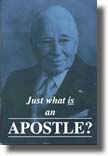
Today we find the Church of God in a “wilderness of religious confusion!”
The confusion is not merely around the Church – within the religions of the world outside – but WITHIN the very heart of The True Church itself!
Read online or contact email to request a copy