SOUTH AFRICA - More than 6 million of the country’s children regularly go hungry, with dire consequences for their capacity to thrive – or even survive – according to the 2018 South African Child Gauge, which urges the government to move swiftly to address the gaps in family services. These children live below the food poverty line which, in real terms, means their families cannot provide even the minimum amount of nutrition they need. Currently, the document says, only a quarter of all South African children live in nuclear families, as opposed to 62% in extended family arrangements. Another factor is the large number of single-person households (22%), created as adult migrants move to cities to seek work, leaving their children behind in the care of family members.
USA - Thanksgiving is nothing to celebrate for Native Americans, who are gathering in the town where the Pilgrims settled for a solemn National Day of Mourning observance. Thursday's noon gathering in downtown Plymouth, Massachusetts, will recall the disease, racism and oppression that the European settlers brought. It's the 49th year that the United American Indians of New England have organized the event on Thanksgiving Day. Moonanum James, a co-leader of the group, says: "Native people have no reason to celebrate the arrival of the Pilgrims."
SOUTH AFRICA - Black Friday is one of the biggest shopping days of the year - and sometimes one of the most violent. With plenty of bargains up for grabs, shoppers can get impatient and even aggressive as they hit the high street. And this year is no different - with shocking scenes already starting to erupt in stores across the world this morning. In their quest to snap up a bargain, shoppers at a South Africa mall were seen breaking into a store as staff tried to keep them out. Footage shows staff pushing against the doors of Baywest Mall, before they begin to break open and people start to flood in. Screams are heard as people begin to run towards the potential bargains, ripping signs and destroying displays in their wake.
UK - When is the UK due to leave the EU? For the UK to leave the EU it had to invoke Article 50 of the Lisbon Treaty which gives the two sides two years to agree the terms of the split. Theresa May triggered this process on 29 March, 2017, meaning the UK is scheduled to leave at 11pm UK time on Friday, 29 March 2019. It can be extended if all 28 EU members agree, but at the moment all sides are focusing on that date as being the key one, and Theresa May has now put it into British law.
UK - Edward Heath “misled” members of the Conservative Party prior to the presentation of his European deal to MPs in the House of Commons, a politician who was there at the time has claimed. British and European diplomats have agreed on Theresa May’s Brexit deal in principle this morning, despite threats from Spain to veto the withdrawal agreement. Finalising Britain’s withdrawal from the European Union could bring an end to almost 50 years of close cooperation with Brussels. However, MPs who debated joining the EEC in 1971 were given false information by then Prime Minister Edward Heath, according to a Tory MP who was at the heart of it as events unfolded.
GERMANY - Angela Merkel has suggested countries should be willing to give up control over their own affairs and let organisations such as the European Union have more power in a veiled swipe at Brexit, as the German Chancellor threatens to derail Britain's exit from the bloc.
FRANCE - The French town of Strasbourg has unveiled its official poster for the European Parliament election campaign featuring an image of US President Donald Trump covered by a star-shaped European Union flag. The poster also features a blurry stop sign and the slogan: “This time, I’m voting!”. Hundreds of posters have been plastered across the eastern French city, the official base of the European Union's Parliament.
IRAN - An Iranian Revolutionary Guards commander chose Thanksgiving to warn the US its bases in Afghanistan, the UAE and Qatar, and US aircraft carriers in the Gulf are within range of Iran missile strikes. Amirali Hajizadeh, head of the Revolutionary Guards’ airspace division, said Thursday Iranian missiles stand ready to respond if America uses military force against Tehran. He singled out US bases and aircraft carriers for special mention as possible targets, naming Al Udeid Air Base in Qatar, Al Dhafra base in the United Arab Emirates and Kandahar base in Afghanistan that host US forces. “They are within our reach and we can hit them if the Americans make a move. Our land-to-sea missiles have a range of 450 miles and the US aircraft carriers are our targets.” he said, according to Reuters.
USA - The parent of a student at a Colorado elementary school is raising concerns over a transgender awareness indoctrination workshop. The Superior Elementary School in Boulder County will show students as young as five-years-old videos from the Queer Kid Stuff Youtube channel, ahead of a performance in late November from the “Phoenix, Colorado’s Trans Community Choir.” “We really don’t believe that you can be too young to learn about inclusivity and differences in the community,” said Boulder County Chief Communications Officer Randy Barber. But one parent says it’s too early for elementary school children to be learning about transgender issues, and reportedly feels the district is “forcing” the agenda on them. We support tolerance and acceptance, but this is simply not age-appropriate.
USA - Thanksgiving week was not supposed to be like this. Normally things are slow in the days leading up to Thanksgiving as investors prepare to gorge themselves with turkey and stuffing as they gather with family and friends. But this year the stock market is crashing, and Wall Street is in panic mode. On Tuesday, the Dow Jones Industrial Average closed at 24,465.64, which is nearly 2,500 points lower than the all-time high of 26,951.81 that was set in early October.
USA - America, you officially have a debt problem, and I am not just talking about the national debt. Consumer bankruptcies are surging, corporate debt has doubled since the last financial crisis, state and local government debt loads have never been higher, and the federal government has been adding more than a trillion dollars a year to the federal debt ever since Barack Obama entered the White House.
ISRAEL - A conference is set to be held in Jerusalem in two weeks which will for the first time, educate Christians on the importance of the Temple Mount. The conference will bring the archaeological proof, refuting the theory that the Jewish Temples were not located where Jewish tradition holds.
EUROPE - The "EU army" is stronger than ever as European nations take action to enhance military cooperation between members states, as tensions escalate across the region, German media reports. The European Union has improved efforts of cross-country military initiatives over the years, giving rise to the probability of a counteractive "EU army", developing warfare tactics with shared intelligence across borders. German newspaper Zeit said: "The EU army is already taking on shape.
GREECE - Greece’s financial crisis has come back to the boil as Athens draws up emergency plans to stabilize the banking system, raising concerns that the country may ultimately need a fourth EU rescue to escape its depression trap. Global risk aversion and contagion from Italy’s parallel banking drama has lifted a lid on the festering legacy of bad debts, and exposed the implausible methods employed by Greek regulators and the EU-led troika to camouflage the problem. Greek bank shares slumped a further 6 percent on Tuesday after five days of falls. They are now down by 60 percent since May, chiefly on fears of drastic state intervention to shore up thinning capital buffers.
USA - Much of today’s incivility and contempt for personal liberty has its roots on college campuses, and most of the uncivil and contemptuous are people with college backgrounds. Let’s look at a few highly publicized recent examples of incivility and attacks on free speech.
Disclaimer:
The views expressed in this section are not our own, unless specifically stated, but are provided to highlight what may prove to be prophetically relevant material appearing in the media.
“Just what is an APOSTLE?”
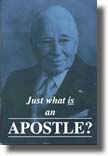
Today we find the Church of God in a “wilderness of religious confusion!”
The confusion is not merely around the Church – within the religions of the world outside – but WITHIN the very heart of The True Church itself!
Read online or contact email to request a copy