IRELAND - Enoch Burke was arrested at Wilson's Hospital School on Monday morning after disobeying a court order and "sitting in an empty classroom" at the school. Schoolteacher Enoch Burke has been charged with contempt of court and committed to Mountjoy Prison after failing to comply with a High Court injunction preventing him from attending or teaching at his secondary school in County Westmeath. He will remain in Mountjoy Prison until he purges his contempt or until further orders from the High Court, Mr Justice Michael Quinn told the court on Monday. Representing himself, Burke said he loved his job and loved to teach, adding that he could not comply with the school's request to "call a boy a girl", which was something he could not do in good conscience. He said he respected the law and the court system but added that he could not comply with the court order as doing so would make him a hypocrite. Burke said he could not purge his contempt because he believed it was something he considered to be a breach of his Christian beliefs.
USA - Dr Paul R McHugh, the former psychiatrist-in-chief for Johns Hopkins Hospital and its current Distinguished Service Professor of Psychiatry, said that transgenderism is a “mental disorder” that merits treatment, that sex change is “biologically impossible,” and that people who promote sexual reassignment surgery are collaborating with and promoting a mental disorder.
USA - Georgia Republican Governor Brian Kemp has declared a state of emergency for two counties in his state as flooding causes heavy damage. Kemp announced the declaration on Sunday after reports of flooded homes and roadways due to ongoing storms across parts of Georgia. “Following severe flooding in North Georgia today, I have declared a State of Emergency in Chattooga and Floyd Counties. As we work with local partners to address the damage in affected communities. The National Weather Service said rainfall of up to one inch per hour and up to 10 inches total had fallen in Chattooga County. “This is an extremely dangerous and life-threatening situation. Do not attempt to travel unless you are fleeing an area subject to flooding or under an evacuation order,” the service said, according to the Associated Press.
UK - A Remain supporter who has become the darling of the Brexit-backing Conservative right wing. A former Liberal Democrat activist, who marched against Margaret Thatcher in the 1980s, but who now claims to be the keeper of the Thatcherite flame. It is fair to say that Mary Elizabeth Truss has been on a political journey. She may not be a household name like her predecessor at Number 10 - and she was not the first choice of Tory MPs to replace Boris Johnson. But her promise to return to fundamental Conservative values - cutting taxes and shrinking the state - proved to be exactly what party members, who got the final say over who took over from Mr Johnson, wanted to hear. And, crucially, as foreign secretary she remained loyal to Mr Johnson until the bitter end as other ministers deserted him, winning her favour with Johnson loyalists. Grassroots Tory supporters of Liz Truss see in her the steadfast, tenacious and determined qualities they admired in Margaret Thatcher - an image Ms Truss herself has tried to cultivate. But despite her shifting political positions and allegiances over the years, these words also come up frequently when friends and family are asked to describe her character - along with "ambitious".
USA - MONOPOLY is one of the best, and most viewed documentaries of all time, even in an age of extreme worldwide censorship, that tries to hide these kinds of truths. But for those of you who haven’t viewed it yet, I want to give a brief summary, hoping this will tickle you enough to watch it anyway, despite your busy schedule. In our world we see millions of brands, names, logos that all seem to compete with one another. There are countless corporations offering different services in clothing, food, travel, technology, agriculture, finance, medicine, and so on. Today all those major brands that seem to compete, are essentially owned by one and the same corporation: Vanguard.
GERMANY - Germany's “neighbors” should set up a joint air defense system amid the Ukraine conflict and other security challenges, Chancellor Olaf Scholz has proposed. “We have a lot of catching up to do in Europe when it comes to defense against airborne and space-based threats. That is why we in Germany will be investing very significantly in our air defense over the years ahead,” Scholz said in a speech at Charles University in Prague on Monday. “At the same time, Germany will from the very start design future air defense in a way that our European neighbors can be involved in, if [they] desire,” he added. The chancellor stated that maintaining a joint air defense shield would be “more efficient and cost effective” than if each country continued to develop its own defense solutions.
GERMANY - In certain critical areas the chancellor has suggested switching to majority voting. German Chancellor Olaf Scholz on Monday called on EU members to abandon the right to veto in favor of majority voting in a number of key areas. Such a move could facilitate the bloc’s future expansion. Speaking at the Charles University in Prague, Scholz argued that changing voting practices may help to grow the EU, given that currently any bloc member can veto the accession of a candidate country. He also suggested introducing majority voting on a number of pressing matters, including sanctions and human rights. “Where unanimity is required today, the risk of an individual country using its veto and preventing all the others from forging ahead increases with each additional member state,” the German chancellor said.
RUSSIA - After a 3-day halt, Russian energy giant Gazprom was expected to resume critical supplies of natural gas to Europe via Nord Stream 1 tomorrow, but it appears that Putin, who is enjoying the game of cat and mouse a little too much, had other plans and as a result, Russian gas flows toward Europe won’t be coming back any time soon, as moments ago Gazprom announced that it had “completely halted” transport of gas to Nord Stream until a previously undetected oil leakage is rectified. The “shocking development” is a massive blow to Europe, which is scrambling to fill up its gas storage ahead of winter and which has been trying to guess Moscow’s next steps in the energy war for weeks. That means that Europe will now be forced to rely even more on… well… Russian gas, in the form of much more expensive LNG resold by China. And after tumbling by more than 50% in the past few days, we fully expect European gas prices are about to go super parabolic and take out all time highs as soon as trading returns on Monday. The news promptly sent spoos [a slang term for index futures contracts on the S&P 500] sliding back under 4000 as any hope Europe’s energy hyperinflation was finally over were just steamrolled by the Russian president.
KOSOVO - Another war in Kosovo has been avoided, but the compromise reached is anything but a solution to the tensions between Belgrade and Pristina. The events throughout late July in the Balkans – alarms sounding at the administrative border between Serbia and Kosovo, locals hastily erecting barricades, gunshots, forces redeploying, calls for peace from the Serbian president and NATO’s vow to intervene should the situation escalate – have led many to believe Europe is on the brink of another war. Yet diplomatic efforts were somewhat successful: Pristina agreed to postpone for a month its decision – the source of the tension in the first place – to bar holders of Serbian documents and license plates from entering Kosovo. This has given diplomats enough time to convince the sides to make mutual concessions and work out a compromise. The resolution will most likely only delay an escalation that has been looming over the region for several decades already. Despite being smaller than Connecticut in the US or Thuringia in Germany, these 11 square kilometers of historic Kosovo lands are still in the middle of a crisis that can affect the whole world.
USA - It’s time to stand up for humanity. Underlying so much of what is wrong in the West now, is a pernicious, baleful belief that there are too many people in the world – that people are the problem. Generations have grown among us that have been taught – actually taught to believe – that our species is some sort of plague upon the Earth, a planet-wide cancer, if you will – that human beings only destroy, only do harm, only contribute one by one and billion by billion to the end of the world. There are uncounted millions of children out there right now who are growing up unhappy and terrified of the future – all because relentless anti-human propaganda dressed up as Green politics and policies – the activities of outfits like Extinction Rebellion and many others besides – have made them feel guilty just for being here and alive.
EUROPE - Russian state-owned energy corporation Gazprom has scrapped plans to restart gas flows through its Nord Stream 1 pipeline to Germany, offering no answers as to when operations would resume back to normal. It is unknown when gas supplies would be resumed. The entire western world is going to start feeling massive pain thanks to weak, ignorant, narcissistic European leaders who balked at sensible advice given to them by President Trump. During a speech at the United Nations General Assembly in September 2018, former President Donald Trump had warned about Germany’s dependence on Russian energy.
USA - President Biden’s Thursday night speech from Independence National Historical Park in Philadelphia, PA last night was universally panned by members of the GOP as divisive; some even called for his impeachment. In remarks that, according to the White House, were not meant to be political, Biden mentioned Trump by name three times and his MAGA — or Make America Great Again — political movement 12 times. “MAGA Republicans have made their choice. They embrace anger. They thrive on chaos. They live not in the light of truth, but in the shadow of lies. Together, we can choose a different path,” Biden said. Prominent GOP voices reacted to the divisive rhetoric immediately on Twitter. Right now in America families can’t afford food or gas and are living in fear as rampant violent crime takes over their cities. What’s President Biden doing? Calling half the country fascists because they won’t go along with his insane agenda. Shameful.
USA - Even as United States President Joe Biden continues to double down on his rhetoric, branding the 'MAGA' supporters of his predecessor Donald Trump as "semi-fascists" and "a threat to our democracy", Republican party faithfuls continue to find new ways to smear their political rival with the most bizarre of insults. This time, they settled on the moniker 'PedoHitler' after the US President's fiery 'Soul of the Nation' speech. Taking to the dias in Philadelphia earlier today, Biden delivered sharp criticism of alleged radicals in the Republican camp amid the dramatic widening of the political divide in the US. Trump supporting Republicans were quick to condemn Biden for his remarks, and some in the MAGA camp compared his speech to German dictator Adolf Hitler's fiery deliveries against the Jews. For the unversed, Republicans have often accused the 79-year-old Biden of being a 'pedophile' (minor attracted person) ever since videos surfaced showing him in close proximity to children at a White House event during his stint as Vice President during the Barack Obama regime (2008-16).
SOUTH KOREAN - A top South Korean security adviser says Washington and Tokyo have agreed to a ‘different’ strategy. While Pyongyang’s most recent atomic test, the sixth in its history, was carried out in September 2017, officials in the US and South Korea have claimed the country has completed “all preparations” for another nuclear trial and is merely waiting for the right moment. According to Seoul’s former intelligence chief Park Jie-won, that could come as soon as November, “ahead of the midterm election” in the US. “They are going to do it in order to demonstrate that their missile can fly to the US, carrying a miniaturized and lighter warhead, and to deal a blow to the Joe Biden administration,” Park claimed during a radio interview last month.
USA - How would you feel if someone pointed a loaded gun at you? Well, that is essentially what our entire planet is facing at this moment. An absolutely enormous sunspot is currently pointing directly at Earth, and it has just developed a delta-class magnetic field. We are being warned that this sunspot has the potential to release an X-class flare, and that would be really bad news, because such flares are often associated with coronal mass ejections. If a large enough coronal mass ejection came directly toward our planet, we could see another “Carrington Event”. In such a scenario, our power grids would be fried, trillions of dollars worth of damage would be caused, and society would instantly go completely and utterly haywire. A one out of 20 chance may not seem like a lot, but if we get unlucky the consequences could be absolutely catastrophic.
Disclaimer:
The views expressed in this section are not our own, unless specifically stated, but are provided to highlight what may prove to be prophetically relevant material appearing in the media.
“Just what is an APOSTLE?”
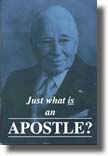
Today we find the Church of God in a “wilderness of religious confusion!”
The confusion is not merely around the Church – within the religions of the world outside – but WITHIN the very heart of The True Church itself!
Read online or contact email to request a copy