- Has dyed hair — specifically purple (cut boyishly if "cis" woman)
- Thinks they get to decide what is "appropriate"
- Displays their pronouns in their bios and is obsessed with gender
- Thinks not having kids is great and is generally misanthropic
- Claims to be bisexual, transsexual, pansexual, etc
- Has a strong regard for authority and enjoys government control
- Hates Russia, loves Ukraine
- Hates Elon Musk
- Votes Democrat and loves socialism
- Hates guns, but (unknowingly) loves war
USA - You have probably noticed that cultural issues are bitterly dividing our nation right now. Bud Light, Target and other companies that have taken controversial stands on cultural issues have been dominating the headlines for weeks, and now the month of June is here. An entire month is set aside to celebrate “Pride”, and you can’t escape it even if you wanted to do so. Rainbow colors will constantly remind us of what we are all supposed to be celebrating, and there will be gatherings and parades in cities from coast to coast. Today, Pride Month has become one of the most prominent holidays in the United States, but it actually hasn’t been around that long. In fact, the very first time it was officially recognized by the White House was in 1999…
TURKEY - The Turkish leader vowed to protect “sacred” family values in his victory speech on Sunday. President Recep Tayyip Erdogan, who portrays himself as a defender of traditional Islamic values, has once again labeled the opposition as ‘LGBT’, and insisted that liberal Western ideology will never infiltrate his ruling party or its nationalist allies. Türkiye’s Supreme Election Council confirmed Erdogan’s decisive victory over Kemal Kilicdaroglu on Sunday evening.
UGANDA - Ugandan President Yoweri Museveni on Monday signed a bill into law that creates harsher penalties for anyone who engages in gay sex, and President Biden has threatened sanctions against the country as a result. While engaging in homosexual acts is already illegal in Uganda, the new law adds offenses to the list and contains harsher penalties, The New York Times reported. Anyone trying to have same-sex relations could face up to 10 years in prison, according to the new law, which also calls for life imprisonment for anyone who does engage in it.
USA - Retail giant Target suffered another financial setback after JPMorgan downgraded its stock as its market value plummeted by $14 billion, amid backlash to its controversial LGBTQ Pride product release. The embattled brand's shares dropped for the ninth consecutive day Wednesday, falling by a further 2.14 percent as the company is in the midst of its longest stock losing streak in 23 years. Before the controversy, the company's market value had been $74 billion, with shares trading at $160.96 at the close of markets on May 17.
USA - Nearly fifty years ago I emigrated from the Soviet Union. My only reason for leaving all that was known to me was a deep longing for freedom of expression. I resented restrictions on foreign publications and deplored the practice of jamming foreign radio stations like the BCC World Service or Radio Canada International. It was as if the media were just obediently regurgitating the party line, with no room for real discussion or debate. Sure, the authorities weren’t as oppressive as they were during Stalin’s reign, but a lingering fear remained. It cast a shadow over political discussions, confining them to a small circle of trusted friends. Expressing our true thoughts and opinions felt like walking a tightrope.
USA - The policing of “information” is the stuff of Naziism, Stalinism, Maoism, and similar anti-liberal regimes. To repress criticism of their dicta and diktats, anti-liberals label criticism “misinformation” or “disinformation.” Those labels are instruments to crush dissent. Not all usages of “disinformation” and “misinformation” come from people intent on shutting someone up. But a lot are. The “anti-misinformation” and “anti-disinformation” projects now afoot or in effect are about shutting up opponents.
USA - There is virtually nobody in either the corporate or alternative media these days who are not warning about the serious problems with US and European banks today. Even if a US debt ceiling agreement is reached this week, it will not save the banking system.
SOUTH AFRICA - Can Pretoria legally grant Russian President Vladimir Putin immunity from ICC arrest in time for the BRICS summit in August? The foreign ministers of BRICS meet in Cape Town on Thursday to prepare for their August summit in Durban amid growing speculation and uncertainty about whether Russian President Vladimir Putin will attend the summit. When the five foreign ministers from South Africa, Russia, Brazil, China and India meet in Cape Town, they will be joined, virtually, by their counterparts from the “Friends of BRICS” — a sign of growing interest from Global South countries in joining this bloc. This new interest has partly been inspired by the growing polarisation between the West and Russia/China over Russia’s invasion of Ukraine on 24 February last year.
SOUTH AFRICA - With a general election next year and an unprecedented series of crises being faced by our society, there is little evidence that our politicians are actively looking for solutions to South Africa’s multiple problems. There is much evidence that our politicians are finding it easier to pick arbitrary fights with each other and within their alternate universe than to spend their time fixing the country’s problems. Coupled with this, the state itself has steadily grown weaker. It appears that those thirsting for political power are more comfortable fighting yesterday’s battles than solving today’s problems.
SOUTH AFRICA - Women continue to bear the brunt of violent attacks in South Africa. In the first three months of 2023, 10,512 women were raped, 1,485 attempted murders of women were reported, 969 women were killed, and over 15,000 women were assaulted. “Women of this country continue to be stalked by violence, mainly at the hands of men. A total of 6,289 people were killed with either a firearm, knife, sharp and blunt instruments and even bare hands, between January and March this year. Most of the killings took place in the KwaZulu-Natal, Western Cape and Gauteng provinces with arguments, vigilantism and robberies topping the motive list for murder.
SOUTH AFRICA - Many white South Africans will be forced to leave the country under the current regime’s latest apartheid legislation. Now new government rules will make it nearly impossible for business owners to hire whites or Indians in the country. Controversial affirmative action policies mean blacks take precedence over whites in the job market. This is the racist reality of South Africa today. This doesn’t make many headlines. Over one million South Africans have migrated in the past 7 years.
UK - They have a new bicentenary slogan on the Oxford Union Society's literature this year: 'Celebrating 200 years of free speech'. Last night, a vociferous alliance from across the 'trans, non-binary, gender non-conforming and intersex' community was doing its best to draw a line under that long and noble tradition by attempting to silence a middle-aged woman who has had the temerity to argue that a person with a penis is not a biological woman. Yet despite repeated attempts to curtail the appearance of Professor Kathleen Stock in the society's famous debating chamber – including a sit-down protester with a tube of glue – it was cancel culture which was ultimately cancelled. As she explained to a packed house – many of whom gave her a standing ovation at the beginning and the end: 'You can go about your life pretending for a while but ultimately reality will hit you in the face.'
USA - CNN spoke with four women who “married themselves” — a self-marriage officially referred to as “sologamy.” The left-leaning news outlet painted “sologamy” as pertaining more to mental health and “self-love.” rather than an extension of living an “auto-sexual” lifestyle — being sexually attracted to oneself — which has been addressed in other news articles on the topic. “The concept of self-marriage, or sologamy, has been around for years… No data exists on how many people celebrate sologamy with ceremonies, but the practice has been explored in a handful of recent news articles,” CNN reported. The women interviewed “described the act as a symbolic expression of self-love and an affirmation of a deep meaningful relationship with one’s self.”
USA - The family-friendly entertainment organization MovieGuide is sounding the alarm about a new campaign against an upcoming Disney+ that features a teenage girl’s love affair with Satan. The streaming platform has given the green light to start production on a new German original series titled Pauline. According to Deadline, the series follows an 18-year-old girl who becomes pregnant after a one-night stand with the devil. The series’ creators, who are behind Netflix’s “How to Sell Drugs Online (Fast),” say the project is “very close” to their hearts. “For a long time, the series has been and still remains a project very close to our hearts,” Philipp Käßbohrer and Matthias Murmann said. “We’re thrilled that Disney+ loves this coming-of-age story as much as we do and that we’ve now been able to begin filming with such an amazing cast and crew.”
Disclaimer:
The views expressed in this section are not our own, unless specifically stated, but are provided to highlight what may prove to be prophetically relevant material appearing in the media.
“Just what is an APOSTLE?”
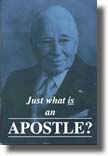
Today we find the Church of God in a “wilderness of religious confusion!”
The confusion is not merely around the Church – within the religions of the world outside – but WITHIN the very heart of The True Church itself!
Read online or contact email to request a copy